
LIGO - A Tale of Great And Small
By now everyone has heard of the recent detection of gravitational waves produced by two black holes colliding a billion miles away. By the time those waves reached us here on Earth they moved us (you, me, everything, the entire planet) a tiny fraction of the diameter of a proton. A. Proton. Not a fraction of an atom. A tiny, tiny fraction of a proton.
For a mere fraction of a second, we were able to detect that motion. As miniscule an effect as it was, and over so brief a time, it was still enough to cause me to get off my butt and drive about five hours to look at the machine built for the specifc purpose of detecting gravity waves.
I propose to describe my visit and some of my impressions here.
I'll begin with: What is a gravity wave? Here's the way I think of it. First, everything that has matter or energy has gravity. Which means everything attracts everything else. And when something moves, it turns out that it gives off waves. It's a bit like waves in water. Throw a rock in the water: waves come off. A boat moves through the water: waves come off.
But we're speaking of gravity waves. So, the moon moves around the Earth: waves are given off. With a water wave, it's pretty easy to see the water move. What exactly is moving when the moon gives off gravity waves? Space itself is moving. Ripples traveling through space. And everything they pass through ripples too.
The moon, even though it's very close, gives off gravity waves much to small for us to detect. Turns out, only really, really big events will even have a chance for us to detect. That's where black holes come in. Turns out, they can generate gravity waves big enough for us to detect, even though they are so very far away.
OK, at this point I suggest you go visit this website where the physicist Brian Green explains gravity waves to Stephen Colbert:
Commentary
‘The Senator Be Embezzling’
A fascinating tale of a state Senator's experience in prison after conviction for obstruction of justice related to violation of federal campaign laws. He's smart, educated and white, thrown into federal prison, full of men exactly unlike him. It's a kind of expose of prison life in the US and well worth the read.
http://www.politico.com/magazine/story/2015/09/mag-prison-smith-213098
Commentary
Human Energy Consumption Comparable To Total Heat Produced By Earth
For those who insist the Earth is just way too large for human activity to make much difference, here's a curious fact.
- Total human enercy production/consumption is estimated at about 17.7 TW (in 2012).
- Total radioactive decay on the planet amounts to about 20 TW.
- And the total heat flow from Earth's interior is about 47 TW.
I was a little surprised that human energy use was in any way comparable to the natural heat flow from the whole planet so I had to check it out, but there you are. Pretty impressive and it means, right there, that we're a significant fraction of the planet's energy budget even now. Be clear, this is still pretty tiny compared to the total energy arriving at Earth from the sun which is about 173,000 TW.
Commentary
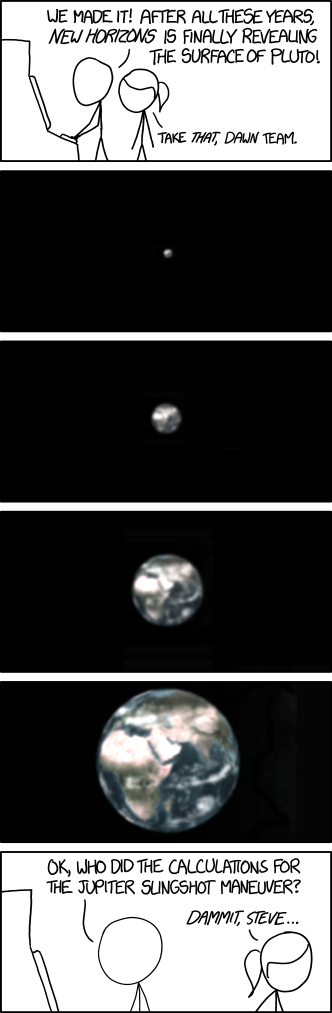
New Horizons
Kurt Vonnegut - Some Writing Advice
Kurt Vonnegut
original posting was on this site
Eight rules for writing fiction:
1. Use the time of a total stranger in such a way that he or she will not feel the time was wasted.
2. Give the reader at least one character he or she can root for.
3. Every character should want something, even if it is only a glass of water.
4. Every sentence must do one of two things -- reveal character or advance the action.
5. Start as close to the end as possible.
6. Be a sadist. Now matter how sweet and innocent your leading characters, make awful things happen to them -- in order that the reader may see what they are made of.
7. Write to please just one person. If you open a window and make love to the world, so to speak, your story will get pneumonia.
8. Give your readers as much information as possible as soon as possible. To heck with suspense. Readers should have such complete understanding of what is going on, where and why, that they could finish the story themselves, should cockroaches eat the last few pages.
-- Vonnegut, Kurt Vonnegut, Bagombo Snuff Box: Uncollected Short Fiction (New York: G.P. Putnam's Sons 1999), 9-10.
See also the attached PDF "How To Write With Style" by Kurt Vonnegut
Commentary
Fundamental Forces
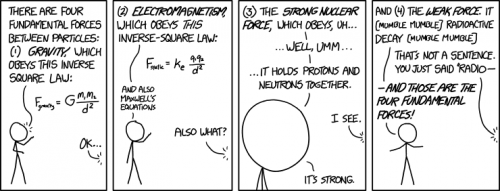
From This Guy, who says it's OK if I post his comics here, which sounds maybe more special than it really is since he says anyone can do it, but still I like to think he knows who I am and said to himself "sure, this cvining.com guy is cool and I'm pleased as punch he posts my comics on his website."
Permanent link to this comic: http://xkcd.com/1489/
Commentary
A bowling ball and a feather walk into a vacuum chamber...
"Physicist Brian Cox of the BBC Two program Human Universe recently visited the world’s largest vacuum chamber at NASA’s Space Power Facility outside of Sandusky, Ohio, to demonstrate the effects of air on falling objects. In the video, a feather and bowling ball are dropped at the same time in normal Earth conditions and after the air has been removed from the room.
"Source: http://laughingsquid.com/a-feather-and-a-bowling-ball-dropped-together-…
Commentary
Tiger food

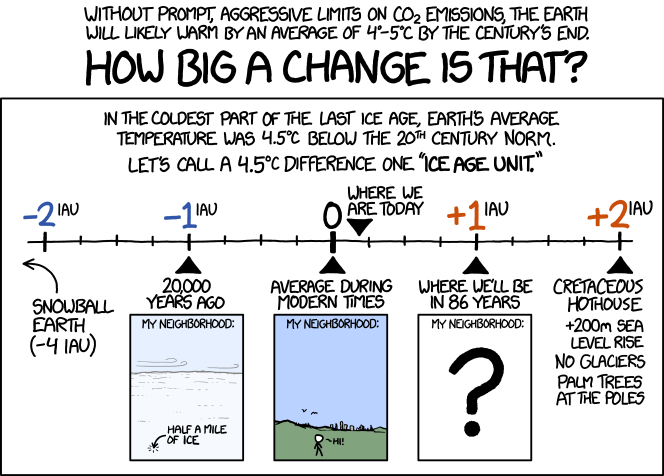
4.5 Degrees
Car theft: Gotta Love It!
From http://seattletimes.com/html/localnews/2023454509_apxdeputyscarstolen.h…
"Spokane County sheriff's officers say a car theft suspect being chased on foot Thursday night by a deputy managed to double back and steal the deputy's patrol car."